

The Disturbing Pseudoscience Behind 'The Body Keeps The Score'
Satanic Panic, Recovered Memories, and a Tale Told in Court Transcripts

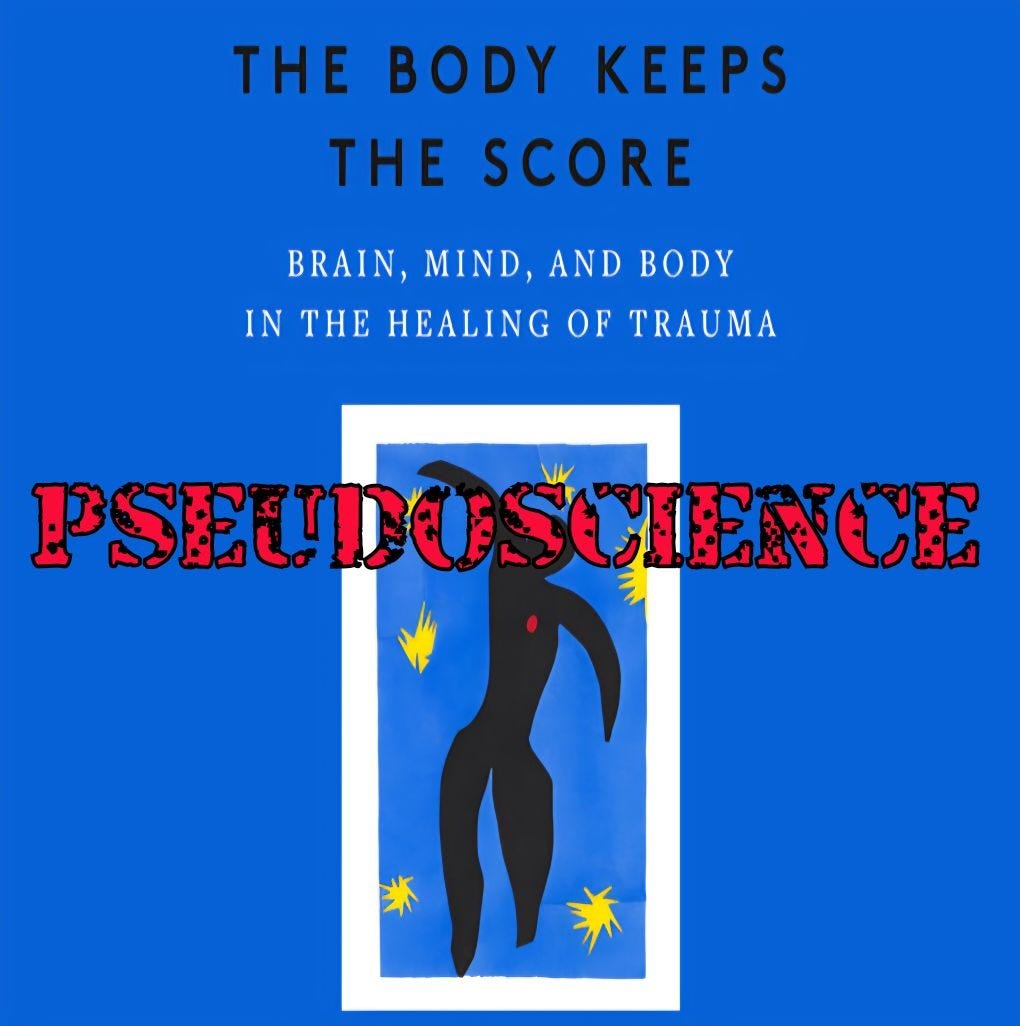
“Do you believe that Satanic Ritual Abuse occurs in this country?,” an examining attorney asked Dr. Bessel van der Kolk, venerated traumatologist and (future) author of the New York Times bestselling book The Body Keeps the Score: Brain, Mind, and Body in the Healing of Trauma during a 1998 deposition for a case in which van der Kolk was acting as an expert witness. “Unfortunately, it does,” [1] he answered.
Years earlier, in a deposition from 1995, van der Kolk was dismissive of Satanic Panic claims, stating, “...[A]ll of these crazy people send me their books because I’m one of their heroes. I get to see all of these crazy books that believe in satanic ritual abuse.” [2]
In 1996, van der Kolk was ambivalent:
Q: Do you believe that there are intergenerational Satanic cults involved in human sacrifices operating throughout the United States and have been operating for hundreds of years?
A: I don’t know, I’ve seen some survivors of Georgetown, and I know that — and some survivors of concentration camps, and I know that people are capable of doing unspeakably horrible things to each other. [3]
However, only months earlier that same year, testifying for a different case, van der Kolk claimed to have seen two people “who were Satanically ritually abused.” [4]
The bizarre line of inquiry focused on discredited conspiracist claims of Satanic cult crimes was relevant to van der Kolk’s expertise, as his testimony sought to defend the notion of “dissociative amnesia” and the reliability of “recovered memories.” During the height of the Satanic Panic there were widely proliferated conspiracist claims of “trauma-based mind-control” -- the theory that secretive, nefarious, and often Satanic or occult underground societies, engage in a program of intentional trauma infliction for the purpose of utilizing “dissociative amnesia” as a tool for turning unwitting individuals into human robots. The concept is an outgrowth of the theory of “dissociative identity disorder” [DID] (formerly known as Multiple Personality Disorder [MPD]). According to this theory, traumatic episodes of abuse can be “repressed,” sequestered away from consciousness in some dark corner of the mind where the ugly memories cause painful dysfunctions, both physical and psychological. The repressed traumas, removed from the individual’s “core personality,” develop into discrete, separate personalities themselves which sometimes claim the foreground of conscious activity. The individual thus becomes “multiple.”
The “trauma-based mind-control” conspiracy theory asserts that “ritual abuse” is intentionally employed by organized, satanic, criminal networks to fracture individuals into multiples, and that these multiple personalities are each individually programmed by the abusers to fulfill certain functions when summoned forth by exposing the mind-controlled subject to certain triggering cues: a gesture, color sequences, tones, etc. As “evidence” for this conspiracy theory was often constructed from recovered memories derived from vulnerable clients of deluded mental health professionals, the question as to whether recovered memories represented actual recollections of events past or collaborative confabulatory fictions that were created in the course of irresponsible trauma therapy was of utmost concern in cases where victim statements were based on recovered memory testimony. Alien abduction, past-life regressions: these concepts, too, were said to be supported by the evidence of recovered witness memories, Not only were the claims implausible, but in some cases thoroughly debunked. In all of this, however, van der Kolk would often assert that recovered memories were more “pristine” and accurate than normal recall.
“Do you think that there is some evidence that false memories can result from the therapist or from outside influences?” van der Kolk was asked under oath (Franklin v Stevenson, 1996). “I don’t know what you are talking about,” he replied.
But Dr. van der Kolk is well aware of these conspiracy theories and, as the court documents demonstrate, he has not always warmly embraced them. He has often brushed aside questions of Satanic Ritual Abuse and recovered memories of UFO abductions as absurdities unworthy of his time…when it is convenient. But van der Kolk has never necessarily been terribly consistent. He may sometimes speak derisively of Satanic Ritual Abuse conspiracy theories -- when directly confronted on the topic and amongst a skeptical audience -- so as to suggest that his theories of “repression” and “recovered memories” are somehow distinct from those that therapists during the Satanic Panic employed to draw forth alleged recollections from clients who reported victimization by a non-existent worldwide Satanic cabal. Yet, he has also long been a regular speaker at the annual conferences for the International Society for the Study of Trauma & Dissociation (ISSTD), an organization that hosts lectures regarding Satanic cult conspiracies, Illuminati mind-control, and other QAnon-like absurdities and insanities. In 2021, when asked if he thought “Satanic Ritual Abuse happens to children,” Dr. van der Kolk confidently and immediately answered, “sadly, it does.”
More than anything, van der Kolk’s publication of the book The Body Keeps the Score: Brain, Mind, and Body in the Healing of Trauma, published in 36 languages and with over 147 weeks on The New York Times bestseller list, established his standing as a world-renowned traumatologist. Despite this, the question of what trauma actually is might result in a different answer from the doctor depending on whatever is most convenient at the moment. In a 2018 interview, van der Kolk said of his termination from his trauma center that “it really is a traumatic event.” In 2019, when asked “what is trauma?” he opined that “trauma is really something that is just so horrendous that you can not encompass it, you can not cope with it. It is too much. Suddenly seeing your best friend getting killed or something that is just like ‘oh my god, oh my god’... Not flunking for an exam or being fired from a job.” [emphasis added]
Van der Kolk’s pet theory of “body memories” -- the idea that the body, instead of the brain, sometimes stores traumatic memories that are too difficult for the conscious mind to process -- could very plausibly have utility as a metaphor when practicing yoga, meditation, massage, theater, or other activities meant to alleviate physical ailments and ease the mind in the service of trauma therapy. But as a scientific claim, there is little to justify it, and it is generally regarded as pseudoscience. The fact that there has been relatively little critical push-back against the concept of body memories, as a neuroscientific reality, may have to do with the fact that there has not been much done to attempt to scientifically validate the idea to begin with. It may also have to do with a disturbingly high tolerance for pseudoscientific practice in the mental health profession where Continuing Education Units are still sometimes granted to licensed practitioners who attend presentations (like those at ISSTD conferences) warning of Illuminati mind-control plots and other delusional fantasies. It also likely has to do with a general spinelessness among scientists and academics who have proven all too easy to harass into silence when aiming needed criticisms against pseudosciences that are marketed as essential components to a moral cause, regardless of how counterproductive to that cause the pseudoscience actually is. Further confusing the issue is the fact that the term “body memory” has been used in science to also describe a confluence of perceptual and internal information that composes one’s experience of their own body. It can’t help that the term “cellular memory,” sometimes used to describe lingering adaptations retained by cells exposed to certain environmental factors, is also sometimes misused as a synonym for “body memories,” perhaps giving it the appearance of scientific acceptance.
If one does not think too deeply about it, the body memory theory may seem to make a type of intuitive sense, potentially describing random anxiety attacks and previously unsatisfactorily diagnosed ailments, bridging the “mind/body” divide. But what the body memory theory really does, is it merely lays a smokescreen over the discredited pseudoscience of “recovered memories.” Whereas other conspiracy therapists from the Satanic Panic era (and many now within the ISSTD) openly focused on the implausible “memories” they claimed to have brought forth from their clients’ unconscious mind, van der Kolk has focused on supposed psychophysiological symptoms of repression instead.
Professor and Director of Clinical Training at Harvard University’s Department of Psychology, Richard J. McNally explains, “Conceptual and empirical problems plague van der Kolk’s theory [of body memories…] Although implicit memory is a genuine phenomenon, it cannot be translated into narrative memory, and it does not show traces of its origins. Accordingly, one cannot assume that spontaneous panic attacks, for example, are implicit expressions of a dissociated memory of a sexual assault. Indeed, although physiologic reactivity to reminders of trauma most certainly does occur, it is accompanied by conscious, explicit memory of the traumatic event. Finally, implicit memory, like all forms of memory, is subject to alteration over time [...]. There is no convincing evidence that trauma survivors exhibit implicit memories of trauma, such as psychophysiologic reactivity, without also experiencing explicit memories of the horrific event as well. Thus, even when the body does ‘keep the score,’ so does the mind.” [5]
Once, when asked if he would object to “something such as hypnosis” being used “to transcribe perceptions into a narrative, van der Kolk replied, “No, I would have no problem with that.” [6]
Perhaps unsurprisingly, then, van der Kolk himself was sued by a former client in 2000 “for injuries alleged to have been caused” by the cultivation of “the false belief” in an autobiographical history of heinous abuse.
Another complaint was filed in 2007 against van der Kolk with the Board of Registration in Medicine (Massachusetts) detailing a bizarre grievance from a former client alleging that he helped the client to recover memories of having been “abducted and held captive by individuals who committed multiple felonies, including numerous murders.” The former client alleged that once she started making progress in her therapy, van der Kolk “took resentment to [her] rapid and independent success.” Seeking corroborative evidence of the crimes against her so as to pursue justice by legal means, van der Kolk allegedly introduced this client to a woman from the Massachusetts Office for Victim Assistance, who was also an active police officer (and former patient of his), as well as a private investigator. Then, oddly, according to the complainant, van der Kolk attempted to persuade the private investigator to charge the client more for her investigation services, and insisted that all communication between the three parties go through him. Eventually van der Kolk terminated the client’s therapy.
What the former client perceived as “resentment” toward her rapid progress seems more likely the result of van der Kolk’s fear of a law enforcement investigation into unlikely claims of abuse derived from his own irresponsible “therapy. The client had expressed her intentions to go to the police in Arizona, where the alleged abuse took place. Re-enrolling in therapy at JRI [Justice Resource Center, van der Kolk’s employer at that time], van der Kolk’s former client alleged that van der Kolk closely supervised her new therapist’s interactions with her.”
But the doctor has, on occasion, proven quite willing to submit his ideas to the scrutiny of lawyers in his capacity as an expert witness (for a fee), with sometimes disastrous consequences.
In 2014, Bessel van der Kolk’s testimony was excluded (on procedural grounds) from a trial involving a multimillionaire mother who murdered her own 8-year old son under the delusion that the child, who was non-verbal and severely autistic, was being tracked and secretly tortured by Satanists who somehow managed to electrocute his genitals, forced him to drink blood, kill animals, and have sex with babysitters and close relatives, without any direct witnesses to, or evidence for, these events. All of this was alleged to have happened even as the mother herself admitted to not having witnessed these horrific acts, and despite almost never being out of the child’s presence. The non-verbal child was claimed to have made these allegations of Satanic abuse himself by way of “facilitated communication,” a discredited method by which a “facilitator” claims to employ subtle muscle reading techniques to help disabled people use a keyboard to type the messages they wish to convey. However, as the Oxford Dictionary of Psychology explains, “single-blind studies and double-blind studies have revealed that disabled people are unable to respond intelligently to stimuli that are unseen by their facilitators and that the facilitators unwittingly control the responses.”
Facilitated Communication had long been debunked by the time that the ISSTD’s Frank Putnam waxed enthusiastic over the murdered child’s uncanny ability to type responses that not merely conveyed basic wants and needs, but at a level of linguistic development far beyond that of a child of his age, disabled or not. The ISSTD’s Ellen Lacter, a firm believer in conspiracy theories involving witches and Satanists, reported that the clearly-deranged mother’s reports of Satanic harassment “were consistent with that of other victims of ritual abuse.” And the ISSTD’s Bessel van der Kolk was called upon by defense attorneys to explain “[h]ow trauma can look like autism. How somebody who is traumatized can look like they are autistic,” apparently in support of a theory that the child’s autism was, in fact, misdiagnosed evidence that he had been ritually abused by Satanists.
The preclusion of van der Kolk’s testimony in this case spared him the embarrassment of examination, but in previous trials, the doctor was not as lucky.
Back in 1995, in the matter of the State of N.H. v. Morahan, van der Kolk was asked:
Q: Are you aware of situations that have occurred where people have claimed to have recovered memories of prior sexual abuse or trauma and have then determined that, in fact, those memories were not true?
A: Yes.
Q: Are you familiar with that?
A: In fact, about half of my patients around Thanksgiving stop believing that their traumas actually happened.
Q: They stop believing?
A: Yeah. Christmas time, Thanksgiving time all my patients say, “I want to go home. I want to have a family.” And all of my patients, almost -- a very large proportion of my patients at that point say, “I must be making that up.”
This is a very disturbing response given the controversy -- well known at the time -- surrounding the use of Recovered Memory Therapies and serious questions surrounding the issue of false traumatic memory cultivation. Typically, advocates for recovered memory pseudoscience insist that their clients are certain of “their truth” and that no persuasion led to the revelations of traumatic memories they hold. Here, van der Kolk was not only suggesting that he was dismissive of his own client’s doubts, but that every one of his patients at that time had implausibly recovered memories of traumatic abuse at the hands of their own families. One might reasonably suspect that van der Kolk was treating any type of psychological malaise as evidence of repressed trauma and helping his clients cultivate a “memory” of that trauma. And, again, his statement also indicates, on van der Kolk’s part, a high degree of trust in the veracity of historical truth in recovered memories, and their superiority over regular memories, that seems wildly unjustified given the strange recovered memory claims of extraterrestrial abductions, Satanic cult crimes, past lives, future lives, and all other manner of bizarre recovered memory narratives that have manifested in the course of “regression therapy.”
Q: [...] Do you agree, Doctor, that the recovered memories controversy is a debate about accuracy, about distortion, about suggestibility in memory?
A: I’m not sure what the debate is about. I sometimes wonder if it is a debate between pedophiles and the people who actually treat traumatized patients. (Franklin v Stevenson)
The reality of recovered memories and the reliability of recovered memories, van der Kolk has insisted, is “generally accepted scientific canon” in his profession . And yet, when being deposed as an expert witness in 1996 by one Dr. Christopher Barden, a clinical psychologist and attorney, it was clear that van der Kolk was not quite clear on certain basic scientific concepts, nor would he admit to any real knowledge of the scientific criticisms surrounding his work. IIn this particular case, on questions regarding the problem of clearly false recovered memory claims of Satanic Ritual Abuse and extraterrestrial abduction, van der Kolk merely dismissed them as outside of his expertise, either ignoring the relevance to his own theories and practice, or simply too dense to understand or accept that he could be hurting his own clients.
Van der Kolk’s expert opinions were declared to be based upon his “clinical experience, personal research, and a review of certain treatises and texts.” As for “personal research,” there were two papers cited. One was titled “The Body Keeps the Score” (then a “review article”) and another paper titled “Dissociation and the Fragmentary Nature of Traumatic Memories” as published in the Journal of Traumatic Stress, volume 8, number 4, 1995. Dr, Barden found that this latter paper was co-authored by a graduate student, Danya Vardi, who had been expelled for falsifying data. While van der Kolk swore that the data had been checked and verified following revelations of Vardi’s misconduct, he subsequently avoided subpoenas for the data, and removed himself from the expert witness list.
In 2018, The Boston Globe reported that Dr. Bessel van der Kolk had “been fired from his job over allegations that he bullied and denigrated employees at his renowned Trauma Center.” For a moment, the teflon doctor, whose reputation has somehow persisted, even flourished, in good standing for decades, despite questions of scientific fraud and a close attachment to discredited, harmful pseudoscientific theories of mind, finally seemed at-risk of falling out of public favor. Untalented at interviews and public speaking, van der Kolk’s appearance of scientific authority seems to reside solely in his western European accent, professorial goatee, arrogant demeanor, and adeptness at marketing. Quick to contextualize any scrutiny of his academic rigor as an assault against trauma victims’ advocacy, or a broad denial of trauma’s adverse and enduring effects, van der Kolk had much to lose in being seen as an abusive person himself. Ugly accusations were made both by van der Kolk and against him, but ultimately untarnished, he established a new foundation for his trauma work, sued his previous employer, and the episode is all but forgotten… much like his previous transgressions that, if committed in most other academic fields, would have ended his career long ago.
***********************************************
Note: this piece contains both hyperlinks and citations. Check out my podcast dialogue about ‘The Body Keeps the Score” on ‘Worldwide Panic’ available on TSTTV and Failed State Update November 18.
Bessel van der Kolk deposition, March 24, 1998, Boston, MA
Bessel van der Kolk deposition. February 14, 1995 (The State of NH v. Joel Hungerford)
Bessel van der Kolk deposition, December 27-28, 1996 (Franklin v Stevenson)
Bessel van der Kolk deposition, August 2, 1996. Third Judicial District Court for Salt Lake County, State of Utah. Case No. 94-0901779-PI.
McNally RJ. Remembering trauma. Cambridge (MA): Belknap Press, Harvard University Press; 2003
Bessel van der Kolk deposition. February 14, 1995 (The State of NH v. Joel Hungerford)
I believe a therapist friend of mine may have recommended "The Body Keeps the Score" to my partner a few years ago. I never read it myself, but it is very disappointing to see how easily pseudoscience can persist in the mental health profession.
It sometimes seems as though simply bringing the (often overused IMHO) word trauma into any conversation immediately implies that the listener should now believe anything alleged by or about the "traumatized" person. I certainly don't mean to discount actual instances of trauma like PTSD, sexual abuse, domestic violence, and so on. It just often feels like the word "trauma" has been so watered down in today's parlance (at least among many of the people in my own social circles) that it can just mean having a bad day, having an argument with someone, or just not liking something. I feel like this confusing (mis)usage acts against the interests of actually traumatized people by grouping them in with the merely disgruntled or edgy.
But when almost any experience can be classified as traumatic (and yet we are still expected to nod and agree), it makes me worry that the general public has little actual interest in seeing false scientific theories of trauma debunked within the halls of academia or the offices of practicing clinicians.
I’m not even surprised this book is incredibly popular.